What do you do when no thought or provision is made for cyclists on the roadway?
It depends on who you are.
If you’re like most people, you’re likely to avoid that road altogether. Awell-known study of Portland, Oregon residents’ feelings about bicycling for transportation indicated that the majority of the public would like to ride a bike if they felt it was safe. The study identified these would-be riders as the “interested, but concerned” segment of the population. These people are interested in riding a bike, but are concerned about getting hit by cars if they ride in traffic. So how many people are we talking about? A whopping 60% of the population. The question is, how do we alleviate their concern?
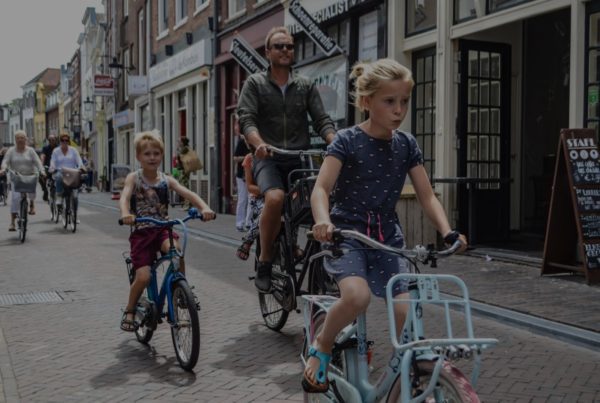
For a very small but highly vocal minority of cyclists, the answer is to train people to be comfortable riding in automobile traffic. But this approach is the opposite of what has been proven to actually help people get on bikes. In the world’s great cycling cities, everybody rides, or knows somebody who rides, because the roads and the laws have been designed to accommodate cyclists, so that “everybody from 8 to 80” feels safe and comfortable riding a bike—without needing special training, and without needing special safety equipment to protect them from cars. The result of taking this approach has been that everybody from 8 to 80 actually does feel safe riding, and therefore everybody from 8 to 80 does ride. And the roads don’t just “feel” safe, they are safe—these are the safest cities in the world for cyclists.
Another demographic, accounting for 7% of Portland residents, already rides. The study identifies these Portlanders as “Enthused and Confident,” and describes them as
“those who have been attracted to cycling in Portland by the significant advances the city has made developing its bikeway network and supporting infrastructure over the past 16 years. They are comfortable sharing the roadway with automotive traffic, but they prefer to do so operating on their own facilities. They are attracted to riding in Portland because there are streets that have been redesigned to make them work well for bicycling. They appreciate bicycle lanes and bicycle boulevards.”
The “Enthused and Confident” demographic is an enormous number (7%) by U.S. standards, where the average share for bicycle commuting has been stuck for decades at less than 1%. But Portland’s numbers pale in comparison to great cycling cities like Copenhagen (where 36% of the population commutes by bike) and Amsterdam (where 60% of all trips in the inner city are by bike).
But there is one more cycling demographic identified in the Portland study—the “Strong and Fearless” cyclists,
“representing fewer than 0.5% of the population. These are the people who will ride in Portland regardless of roadway conditions. They are ‘bicyclists;’ riding is a strong part of their identity and they are generally undeterred by roadway conditions—though likely few are courageous enough to venture too far up West Burnside into the West Hills.”
In other words, if Portland’s much-vaunted cycling numbers included only those cyclists who are actually fearlessly comfortable riding in automobile traffic without bicycle infrastructure, the number is less than .5% of residents, which is approximately the national average of people who will ride a bike despite the absence of infrastructure.
The fact is, most people simply don’t want to take what they perceive to be risks with their lives. Just about everybody wants to come home to their families at the end of the day, and most people have very real concerns about riding in automobile traffic. This fear is a barrier to getting more people on bikes, and brushing it away with recommendations that people learn to ride with traffic does nothing to alleviate that fear.
And in fact, over the last 40-plus years, these two very different approaches to helping people feel comfortable riding bikes have been put to the test, with very telling results. Where bicycle infrastructure (including both physical and legal infrastructure) has been implemented, people ride their bikes in high numbers. Where it hasn’t been implemented, very few people feel comfortable riding their bikes.
Now, returning to the question “What do you do when no thought or provision is made for cyclists on the roadway,” again, it depends on who you are.
If you are a particularly brave, determined person, you may decide to ride anyway. That is what Cherokee Schill did when she began commuting by bike in Jessamine County, Kentucky. And because the roadways had been built with no provision or thought for cyclists, she was forced to choose between riding on a shoulder littered with potholes, rumble strips, gravel, and other assorted surface hazards typical of an automobile-centric roadway system, or taking the lane on a highway with a 55 MPH speed limit. Most people would probably just give up. Cherokee chose to take the lane.
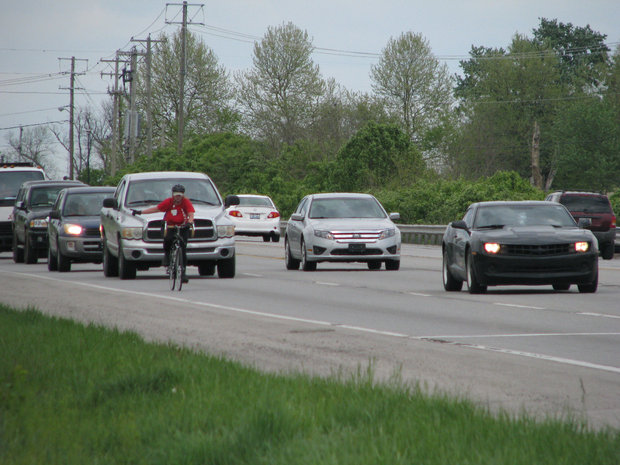
But if you are the local prosecutor, you may see things differently. You may decide that riding in the lane is “careless driving” and “failing to keep to the right” and needs to be corrected with law enforcement action.
Which is exactly what happened in Jessamine County. Law enforcement officers were directed to cite Cherokee whenever she was encountered taking the lane. But Cherokee continued riding, undeterred. After she racked up 3 citations, the prosecutor went a step further and attempted to obtain a court order banning her from the road. This was an extraordinary measure. Cherokee hadn’t been convicted of anything yet—her court date was months away. It’s inconceivable that a motorist would be hauled into court for a hearing on whether the motorist should be banned from the road, when the motorist hadn’t even been convicted of violating a single law. And yet that is exactly what the prosecutor was seeking to do with a cyclist whose only alleged offense was riding on the roadway istead of the shoulder.
Fortunately, the judge who heard the prosecutor’s motion had the good sense and judgment to refrain from issuing the requested ban. There would be no pre-trial court order removing Cherokee from the road; the entire issue of whether she was violating the law would have to be argued at trial.
Months passed, until finally, this Friday, Cherokee Schill appeared in court to answer a total of 6 charges against her. The prosecutor, who has approached this as a safety issue, made a well-intentioned but somewhat confused argument about the law. In Kentucky, the law says that
“The operator of any vehicle moving slowly upon the highway shall keep his vehicle as closely as practicable to the right-hand boundary of the highway, allowing more swiftly moving vehicles reasonably free passage to the left.”
There are two significant sections of this statute which were at issue in Cherokee’s trial, and despite winning his case the prosecutor was on the wrong side of the law on both issues.
First, the prosecutor argued that under Kentucky law, slow moving vehicles are required to keep as far to the right as possible. One problem with his argument problem is that Kentucky does not use the words “as far as possible.” It uses the words “as closely as practicable.” And they don’t mean the same thing. In fact, it could be argued that “as far as possible” and “as closely as practicable” are the antithesis of each other.
“As closely as practicable to the right”
When a law says that cyclists must ride “as closely as practicable to the right,” the law is saying that cyclists must ride as far to the right as can reasonably be accomplished under the circumstances. A key word in that definition is “reasonably.” A cyclist might be able to attempt to ride on the furthest edge of the shoulder, precariously balancing on the furthermost edge of the pavement, attempting to avoid falling off the shoulder into the dirt. That might be “possible,” but it would not be “reasonable.” A cyclist might be able to ride on a shoulder, strewn with glass, gravel, potholes, and rumble strips, darting in and out of traffic to avoid the surface hazards. That might be “possible,” but it would not be reasonable. Instead, what the law requires is what the cyclist can “reasonably” accomplish under the circumstances.
But who decides what is “reasonable”? That’s an interesting question. Clearly, the cyclist has to make the call as to what is reasonable and safe. But everybody is different, with differing standards for what is “safe” and “reasonable,” so the cyclist’s judgment is also subject to the “reasonable person” standard. This means that if the legality of the cyclist’s judgment is called into question, the courts are supposed to measure the cyclist’s judgment about what is “safe” and “reasonable” against what a hypothetical “reasonable person” in this community and under these same circumstances would do in this situation (answers to this question don’t get to include a suggestion to “drive a car!”).
So, for example, if a “reasonable person” is faced with a question of how far to the right to ride, the question revolves around where the reasonable person would choose to ride—taking the high-speed traffic lane with automobiles? On a shoulder littered with surface hazards? On the fog line? Alternating between good sections of shoulder and the right side of the traffic lane? Ultimately, it is the hypothetical “reasonable person” who decides. And in traffic court, that means it is usually going to be the judge who decides what is “reasonable,” and what is unreasonable.
“A usable shoulder”
Now, I said that the prosecutor made a well-intentioned but confused argument. Although he got the law wrong when he said that Schill is required to ride as far to the right as possible, he got the law right when he discussed riding on the shoulder:
“‘If the shoulder is usable, and it’s practicable for it to be used and it can be safely used, and you’re moving more slowly than other traffic on the highway at the time, you are to get as far to the right as practicable, [Prosecutor Eric] Wright said.”
This argument raises some questions, however. Is the shoulder actually “usable”? What does “usable” mean, exactly? Does it mean that there’s a shoulder? Or does it mean something more? By the prosecutor’s own argument, it’s clear that the cyclist is only required to use the shoulder under the following conditions:
1) When the cyclist is moving more slowly than other traffic on the highway at that time; and
2) If the shoulder can be reasonably and safely used under the circumstances.
And that brings us back to the “reasonable person.” Would the reasonable person ride over rumble strips, potholes, gravel, and broken glass, or would the reasonable person move left, and avoid these hazards? Would the reasonable person move left and take the lane? Or would the reasonable person ride the fog line? Or would the reasonable person alternate between riding usable sections of shoulder (assuming that there are usable sections of shoulder), and the fog line?
To some extent, this is theoretical. But it’s also evidence-based. The prosecutor can argue that the shoulder is “usable,” and “safe,” but that argument should be supported by evidence. Otherwise, the prosecutor’s argument is just the opinion of somebody who hasn’t actually attempted to determine if the shoulder is “usable” and “safe.” Likewise, Cherokee Schill can argue that the shoulder is “unusable,” and “unsafe,” but that argument should be supported by evidence as well.
I wasn’t in the courtroom, but I’ve seen Cherokee’s videos, and the shoulder doesn’t look usable to me. And just to be clear, when I chatted with Cherokee about her case, I suggested that she ride on the shoulder (before I saw her video). So when I say that the shoulder doesn’t look “usable” to me, I’m not opposed to riding on the shoulder. I’m simply saying that I probably wouldn’t ride this shoulder because it doesn’t look usable.
“Free passage to the left”
There’s one more piece of the law that the prosecutor studiously ignored. The law doesn’t simply require cyclists to ride to the right. It’s more nuanced than that:
“The operator of any vehicle moving slowly upon the highway shall keep his vehicle as closely as practicable to the right-hand boundary of the highway, allowing more swiftly moving vehicles reasonably free passage to the left.”
Under this law, “As closely as practicable to the right” doesn’t just mean ride as close to the right as can reasonably be accomplished. It also means riding far enough to the right to allow more swiftly-moving traffic free passage to the left.
And that is exactly what Cherokee Schill has been doing. One can argue about whether it was reasonable for Cherokee to take the lane, or to ride further to the right. But nobody can argue that she has impeded free passage to her left. The law doesn’t require Cherokee to allow free passage to swifter traffic in all traffic lanes. It just requires that she allow faster traffic to pass her.
The Bottom Line
If a cyclist is riding at a slower speed than other lawful traffic at that time and place, and if there is a safe and usable shoulder, then the law requires her to use the shoulder. But if there is not a safe and usable shoulder, then the law merely requires that she ride as close as she reasonably can to the edge of the highway, and allow faster traffic to pass to her left.
But the condition of the shoulder notwithstanding, Cherokee lost her case. She was convicted on 6 charges, and fined $50 for each of the 6 charges. She says she will appeal.
Coming full circle, what is this case really about?
The prosecutor will say it’s about safety (And in an irony that may be lost on the prosecutor, so does Cherokee).
The vocal minority of advocates who call themselves “bicycle drivers” and who want all cyclists to ride in the lane with automobile traffic will say it’s about a cyclist’s right to the road. This, of course, ignores that there is nuance and context about where we may ride.
But ultimately, it’s about the shocking failure of the transportation authorities to give any thought or consideration to accommodating anything other than motorized traffic on their roadways. The only way for Cherokee to get from her home to her job is to take a high-speed highway. There are no quieter, calmer “alternate routes.” There is a shoulder on the highway, but it has been rendered unusable both by design, and by neglect. Where is the protected bicycle lane? Where is the low-speed alternate route? Automobiles are the first and only priority in Jessamine County, and then, when a cyclist attempts to negotiate the existing infrastructure, she is criminalized, harassed by the prosecutor and by local law enforcement, and by Jessamine County motorists, who feel emboldened to use their vehicles as weapons, because law enforcement looks the other way when they do.
This isn’t about a failure of Cherokee Schill to obey the law. It’s about a failure of the local and state authorities. If this were a county that cared about cyclists, cyclists like Cherokee would be riding in the protected bike lane, along with thousands of other residents, and nobody would see them as a target for their bullying, lawful and otherwise. But here, she has been given no other choices, and then criminalized for making the only choice left to her.
And that is the real crime.